Galleria d’Arte Moderna e Contemporanea di Bergamo, Bergamo
1 October 2026 – 24 January 2027
by VERONICA SIMPSON
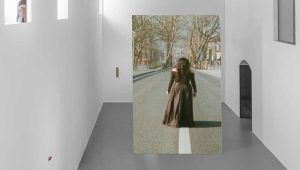
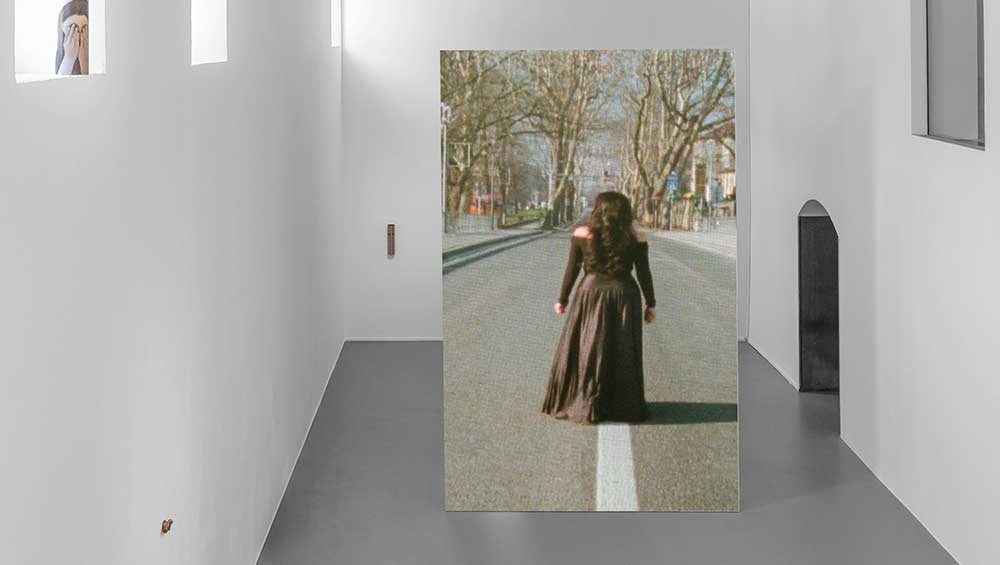
The space is an austere, high-ceilinged, stone-walled white room that could be a cell or a chapel – and as Galleria d’Arte Moderna e Contemporanea di Bergamo (GAMeC) was once a convent, it might well have been either. A tall screen plays a collage of atmospheric moments. We see the reflective dazzle of winter sunlight on a river. A young woman with flowing, black hair, dressed in a billowing, ankle-length black skirt and figure-hugging T-shirt, is striding across an empty bridge. We see her from afar, sideways. We zoom in to follow her from behind as she walks along the middle of an empty road. In closeup, the camera captures the wind blowing her hair across her face. Then it frames the act of what looks like handwringing, but turns out to be her rolling and lighting a cigarette. A clapperboard appears on the edge of the screen, indicating another take. Then we resume following this woman over the bridge – crossing, always crossing. She never reaches the other side in this seven-minute film.
Then the same young woman, dressed in identical style, emerges from behind the screen and strides towards us. While her outfit is now an inky, blue-black, couture version, the choreography is arresting. It feels staged. Is it a performance? Or simply a demonstration of Selma Selman’s natural presence and charisma.
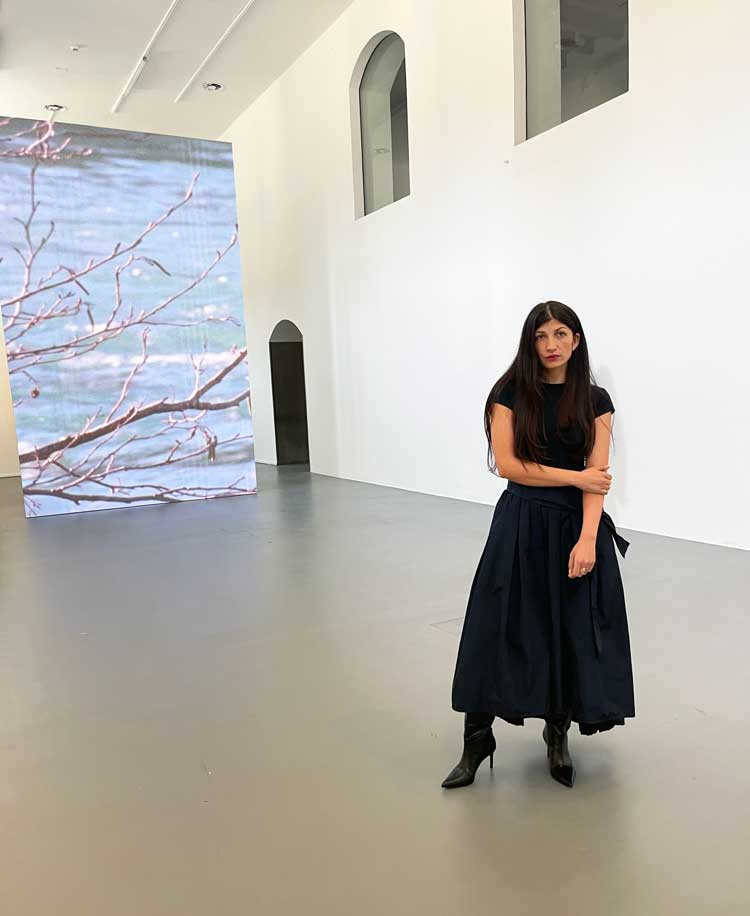
Selman (b1991, Bosnia and Herzegovina) is strikingly beautiful. And this filmic river, this sparkling sunlight on water forms a dramatic backdrop for her raven black hair, clothes and luminous good looks. Though she is softly spoken, her manner easygoing, approachable, Selman has a stillness about her, a composure; she is aware of her currency. She is very much the rising star, propelled by the anger and activism of her origin story, as a member of Europe’s biggest, most marginalised Indigenous community, not to mention her ancestral and lived understanding of inherited trauma – she was born just before the start of the Bosnian war. These narratives are woven into her work, across performance, film, painting, drawing and sculpture.
She was born into a Romany community and her childhood was hugely affected by the Bosnian war, which took place between 1992 and 1995 and presaged the breakup of Yugoslavia, and in which more than 100,000 Bosnian Muslims died. It is her mother’s wartime memory she is enacting in the aforementioned performance and film – an abridged version of an earlier work, Crossing the Blue Bridge (2024). She says the Blue Bridge in Bihać was bombed as her mother was returning home from the market, with groceries. The bridge stood between her mother and her family, but it was strewn with the dead and the wounded. “She had a basket of food in one hand and was covering the eyes of my sister with the other hand,” says Selman. “Then the wind came and blew her hair across her eyes so she wouldn’t see anything. Nature was helping her.
“How do you turn something like that into resistance? This is a site-specific performance work. It’s on the same bridge, at the same time of day, the same day of the year. The only thing we couldn’t repeat was the snow. But it’s -3C.” Though she admits it’s her mother’s memory she relives, not her own, she says: “I think you can have transgenerational traumatic experiences. Somehow you live through the memory of your people.”
Knowing beforehand what inspired this film, seeing it is powerful. But it strikes me that if you were unfamiliar with that narrative, the film doesn’t convey anything of it. You see a young woman, endlessly crossing a bridge on a sunny winter’s day.
Selman is billed by GAMeC as “one of the most significant voices on the international art scene”. After graduating in 2014, from the department of painting at Banja Luka University, she received Bosnia’s Zvono Award for young artists. In 2017, she won the Young European Artist Trieste Contemporanea Award, and in 2018 – the same year she graduated from New York’s Syracuse University with an MFA in transmedia, visual and performing arts – she was nominated for the Forbes 30 Under 30: Art and Style. She enjoyed two years on a residency at the Rijksakademie in Amsterdam, and many group and solo shows have followed. This is her first solo show in an Italian institution.
Selman has something of the daring fearlessness of Marina Abramović, particularly the work of the latter’s early decades. They share a desire to articulate pain and anger, expressing and activating conflict through work and performance. Selman’s traumas are of a very different and specific nature, however. Abramović started out exploring the best and worst of human instinct through her challenging setups, pushing herself, or her fellow performers and audience, beyond the boundaries of social convention to the edge of (self-) destruction. Selman’s activism comes from wanting to liberate herself, and her fellow Romany females from the burden of servitude and suppression of opportunity that is their traditional inheritance. One of the works that put her on the map was I Will Buy My Freedom When, a performance as well as a filmed work. In it, she rejects the Romany tradition of marrying off young women for the sake of a bride dowry by asking her mother, father and brother what her dowry is “worth” to them. Their figure came to about €11,000. She managed to raise the money, gave it to her family, and thus “liberated” herself.
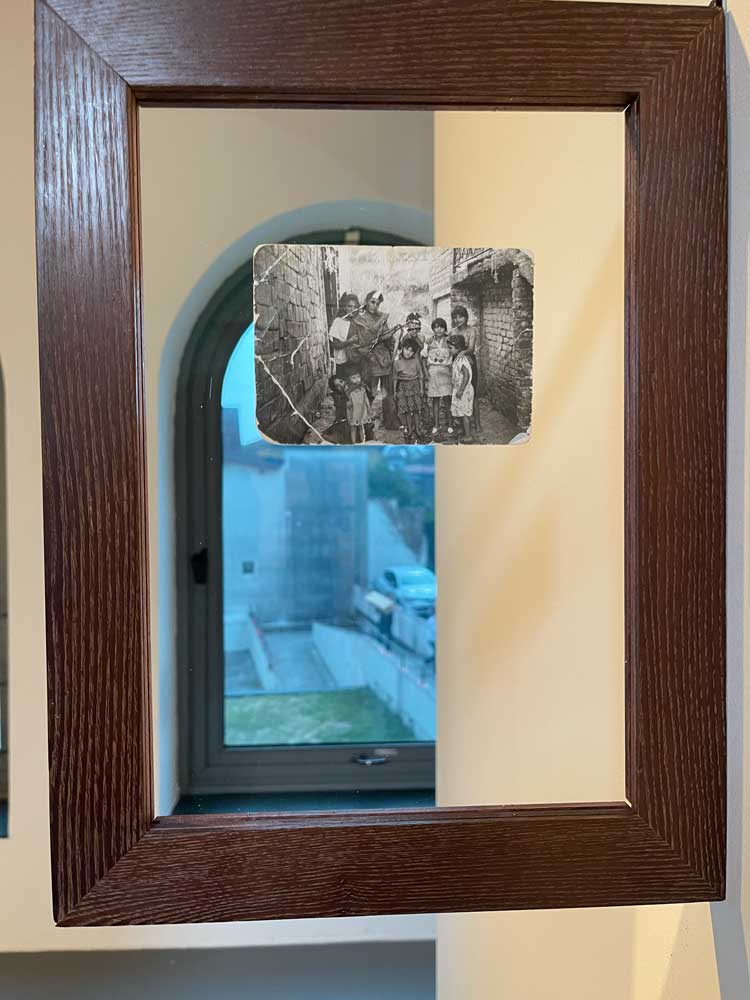
Selman acknowledges Abramović as an influence, but also speaks in Bergamo of her mother as a hero: married at 12, she had her first child at 13, and went on to have four more, of whom Selman is the youngest. She had nothing but encouragement from both parents, despite the lack of precedent of anyone from her community studying art (a situation she is trying to change, through example and her foundation, Get the Heck to School, which gives scholarships to children in Bosnia).
She has also amplified the importance of her family history as scrap merchants by making salvaged metal a core element of her work. The gallery is scattered with repurposed pieces of car, or things that look (to a non-mechanical mind) more like plumbing, which she uses instead of canvases. She started painting on metal while at art school: when she couldn’t afford canvas, her father offered her some scrap he wasn’t using. Her painting skills were honed on this material, with car bonnets dominant.
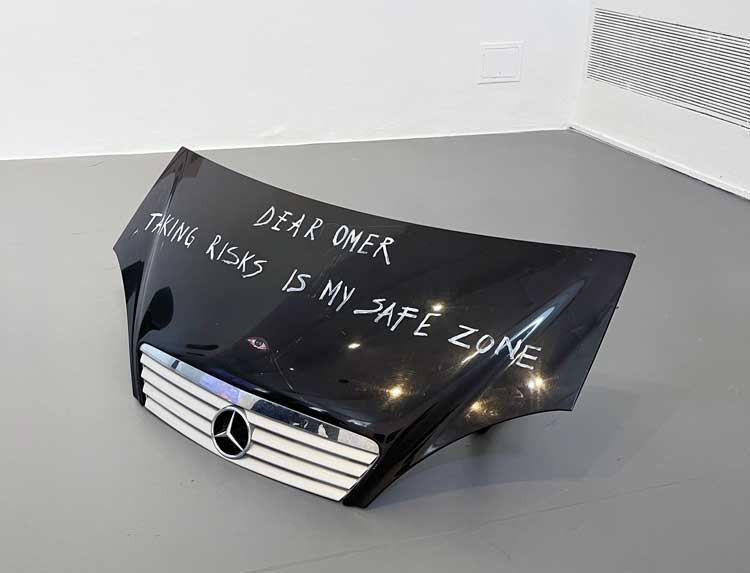
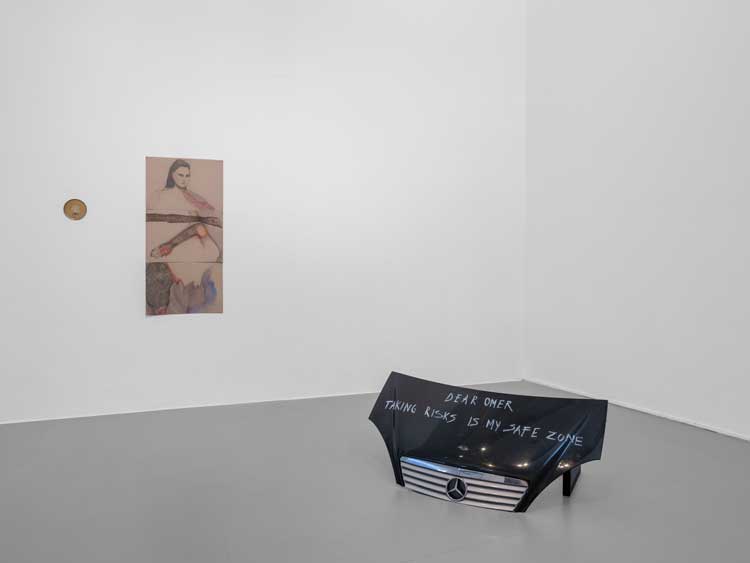
One of the characters that appears in much of Selman’s work is her imaginary “male muse”, Omer – whom she describes as the best and worst of muses. Some of the painted car bonnets in this show feature messages to “Dear Omer”. Over the years, she has written copious letters and poems to Omer, some of which have been gathered in a book of writings published for this show by GAMeC. Bound in a striking, vermilion cover, it sits on a white plinth at the far end of the second gallery.
Her messages to Omer veer between hatred and rapture. In the foregrounding of this intense, albeit imagined, emotional interplay, it feels as if she might be echoing the dramatic conflict, the push-pull chemistry of Abramović’s relationship with her German partner, Ulay. Their ferocious interactions formed the bedrock of some of Abramović’s most riveting filmed performances. But viewing the films of these early performances where the couple scream at each other, or Ulay appears on the brink of firing an arrow through his lover’s heart, we are drawn into the crisis. We can all relate to what they are going through: the dread or the thrill – the reality of it – supercharges the experience. The fictional element of Selman’s scrawled poems or messages renders them less intriguing. They are not so different from the angst-ridden journalling of a teenager to the lover of her dreams/nightmares.
There is certainly a confident, destructive energy in her paintings on these trashed car bonnets – often, if not always, from Mercedes. She is despoiling these shiny things – these totems of conspicuous consumption and luxury engineering – with thick black paint. In a twinned bonnet work, a gothic scene is played out on one bonnet: a woman with long dark hair (very like Selman) bends forward, towards us, in submission, exposing her bare neck, shoulders and arms; fluid (too pale to be blood, but pink like something corporeal) drips from her fingers. There is menace in the shadowy, faceless figure looming behind her. An incantation to Omer is scrawled, white paint on black, on the bonnet beside it: “Dear Omer, I know I did my best. Screamed prayers until I reached the ninth heaven. I fought gods. I had to learn to love myself. Who will love me at the end of the world if my past does not love my future.” For me, it’s too redolent of the online world of self-help Instagram aphorisms or the confessional blogging of the perpetually self-absorbed. But it’s bang-on for a gen Z audience, as is Selman, who has more than 24,000 followers on Instagram and is attended at this preview not just by art critics but a couple of endearingly enthusiastic professional fashion stylists and lecturers in fashion journalism.
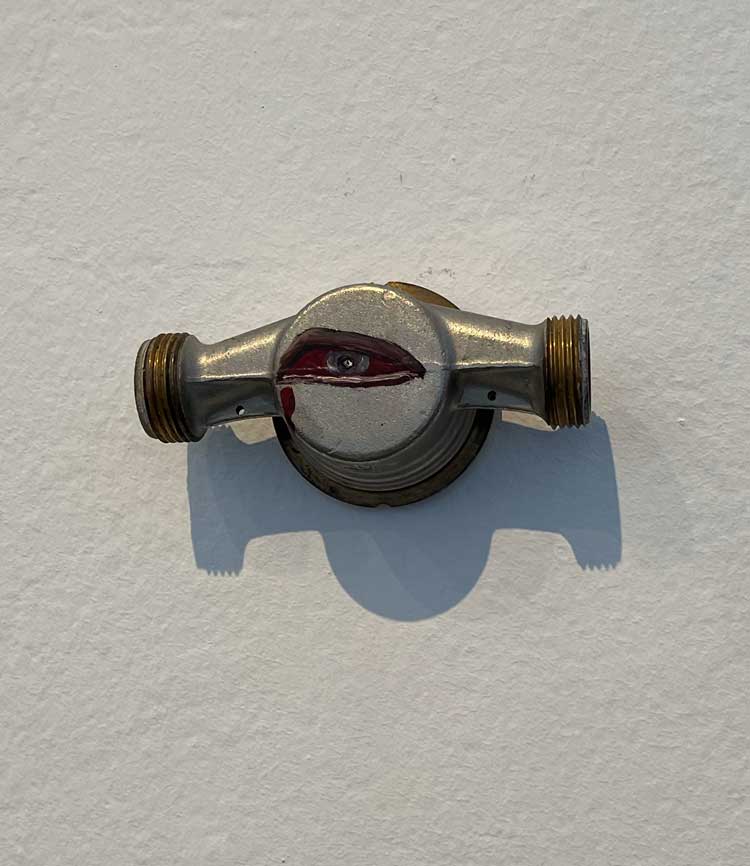
Around the room, other metal components are painted with eyes, heads or bodies. On the wall, there is a metal disc with an eye in its centre. Nearby is a metal spigot with an eye, the white of which appears to be filled with blood. A metal cylinder is perched up high on a window ledge, depicting a version of Selman hiding her eyes with her hands. They all appear to be Selman’s piercing grey-blue eyes.
“I love eyes because in my culture they are dualistic,” says Selman. “They can be protection, but they can also be the ghosts of something. In every show I put a few eyes, to protect myself from bad people.”
It is interesting that Selman makes a point of evoking her culture and history in the inspirations for, and expressions of, all her work, while calling herself “superpositional”. In interviews, she often says she doesn’t want to be labelled a Romany or Bosnian or American artist (she lives between Bihać and New York), but surely her identity is what infuses her work with an extra charge – the lived experience of marginalisation and oppression in a world increasingly fragmented by bigotry and nationalism. Her identity is part of her art’s DNA, and a valuable trigger for empathy.
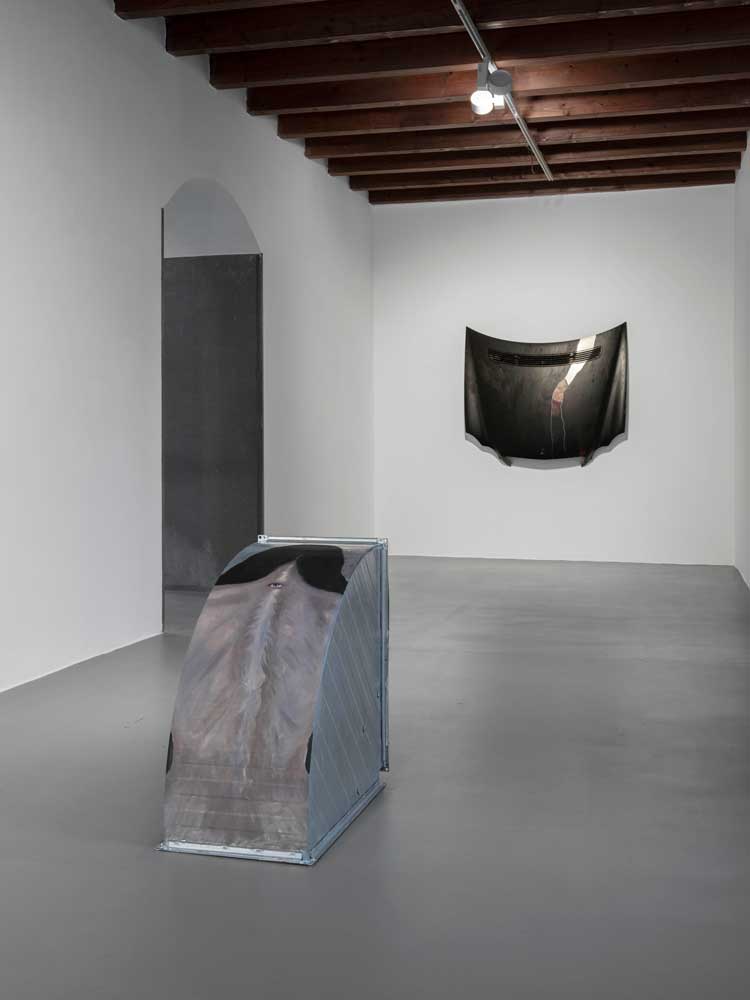
As we move through the second room, a curving metal shape looms up from the ground, featuring a painting of a naked woman seen from behind, leaning forward. It is called (as are three other works) Medusa (Do Not Look Into Our Eyes) (2026). This work may be related to those first shown last year at Kunsthuis SYB in the Netherlands, in a show called 600 years of Migrant Mothers. It featured a timeline and multiple drawings and portraits of the titular mothers, along with two sculptures using sections of repurposed aluminium milk tanks painted with female figures. That milk-tank origin is clearly resonant. And there is great social and cultural value in celebrating the sacrifice that women, especially mothers, make in taking huge risks to relocate their families, to try to find sanctuary. It’s a cause worth shouting about. With lived history of that in your background, there is no need to be “superpositional”.
Selman has important things to say and, at times, has found profoundly affecting ways to say them. A presentation of her work at Frieze London this year drew praise from many. But I am sceptical about the value of some of the smaller metal elements as art objects. Scrap metal has its own currency, for sure. But look at how a mature master such as El Anatsui, uses it: the qualities of the material, its arrangement, the clarity of its origin along with the beauty of its composition within the larger pieces, establish his works as masterpieces. Simply painting an eye, a face or a naked torso on to scrap metal, not so much. And when it so vividly reflects the artist’s own eye, face, body, they come to seem more like fetish objects, totems, shamanistic offerings that play on the artist’s own allure and myth-telling.
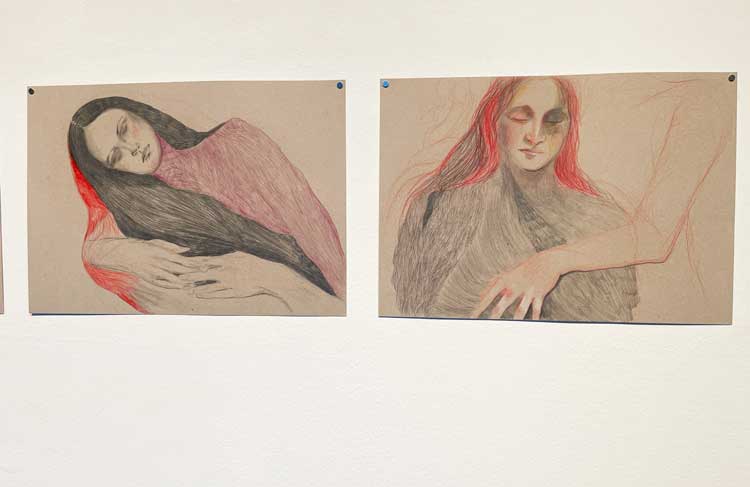
She talks a lot about transformation. For example, in describing the drawing series that debuts here: 1000 tears. In this ongoing series of portraits of women she knows, she is attempting to show layers or shadows of trauma in their anatomy. The drawings are nice enough, but they look more like preliminary sketches. I’ve seen equally skilled portraits in a sixth-form art show. And what are these often grey, or pinkish, densely cross-hatched shadows? Are they supposed to be phantom limbs? Some snake across or around these women’s bodies, but they don’t tell us anything of what they represent or where they come from. According to the show’s publicity, Selman’s childhood memories are sometimes affected by “persistent darkness, where memory coincides with incomplete and sometimes inaccessible images”. If these drawings are intending to conjure similar layers or traces of memory, they fail to convey that feeling or sensation. The series was inspired by a dream, she says. “Dreams are very important in my culture. How do you use the pain? How does pain transform into something you can use to oppose the system.” If they are exploratory sketches, perhaps they might resolve into a bigger, bolder work that lives up to her talent.
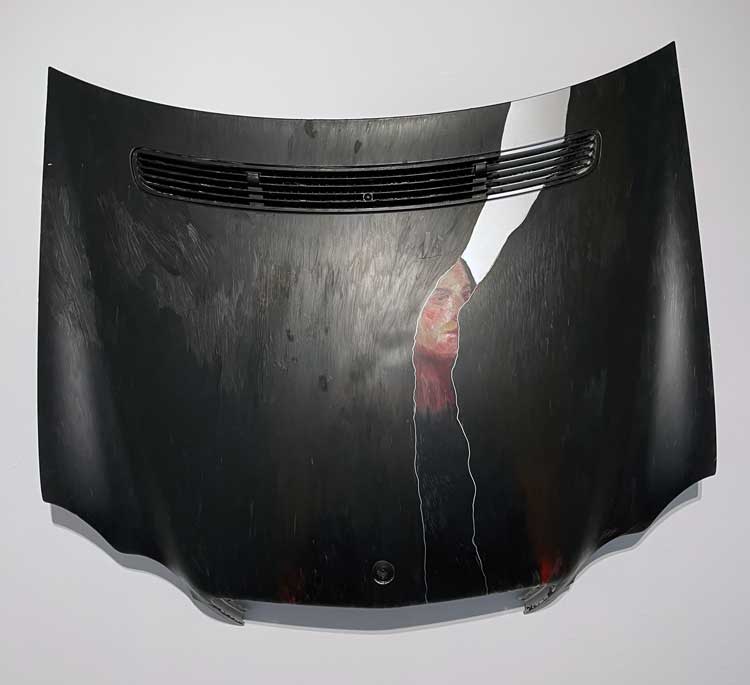
One of the Medusa works here, painted on a car bonnet, features a woman’s face, turned sideways, as viewed through a jagged tear in the otherwise thick, black veil of paint covering the metal. Asked about this piece, she says: “I was raised to be in a very traditional religious place, being a Muslim and understand it was important. And sometimes I like to play with that – to create religious moments but to do something different.” Which brings us back to the idea of her art as ritual elements, totems to be rearranged to conjure atmosphere. The alchemical choreography of ideas and images, of histories and resonant materials, in this show have power – especially in her presence. But do they convey as much in isolation?
She says: “The show proposes a new future. That we can always find something in ourselves.” I am rather hoping that she can persist in finding more of that something she undoubtedly has in herself, going deeper, being more rigorous in developing her own practice. She would do well not to follow in the footsteps of Abramović who, after decades of developing the most rigorous and challenging of performance practices, has now taken to claiming that physical props that might have been used in her meditations or endurance art performances – such as blocks of crystal, or suspended platforms for meditation – are artworks in and of themselves, trusting that the shamanic charge of her authorship is enough to elevate them, even if others have made them. To me, they smack of new age snake-oil merchantry. In an era of anxiety, youngsters raised on social media algorithms are all too used to outsourcing their own power and agency to self-proclaimed “gurus”.
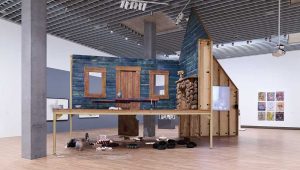
Either way, Selman’s show forms a thought-provoking conclusion to GAMeC’s impressive 2026 programme, the Pedagogy of Hope. Its core principle is to “learn to unlearn”. Selman is already a beacon of hope for young Romany women, as her own self-realisation and her educational foundation testify. There is a rather more practical counterpoint exhibition in Bergamo’s Palazzo della Ragione. Here, set within an inclusive, educational laboratory designed by the Italian collective Fosbury Architecture, visitors can participate in experimental workshops underpinned by the literacy programmes of Brazil’s 1960s radical Paulo Freire, designed to empower the country’s ignored and underrepresented communities in their own self-education.
Whether playing with geometric tiles that question our understanding of the robotic nature of digital algorithms, finding objects that we don’t know the name of and making up stories about them, or being tasked to remember our own inspirational educational experiences and record them for an archive, this interactive exhibition will leave visitors more alert and awake to the power we all have to develop own creative presence and potential.