by LILLY WEI
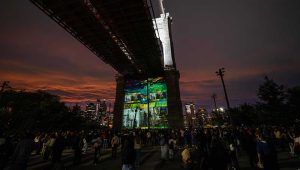
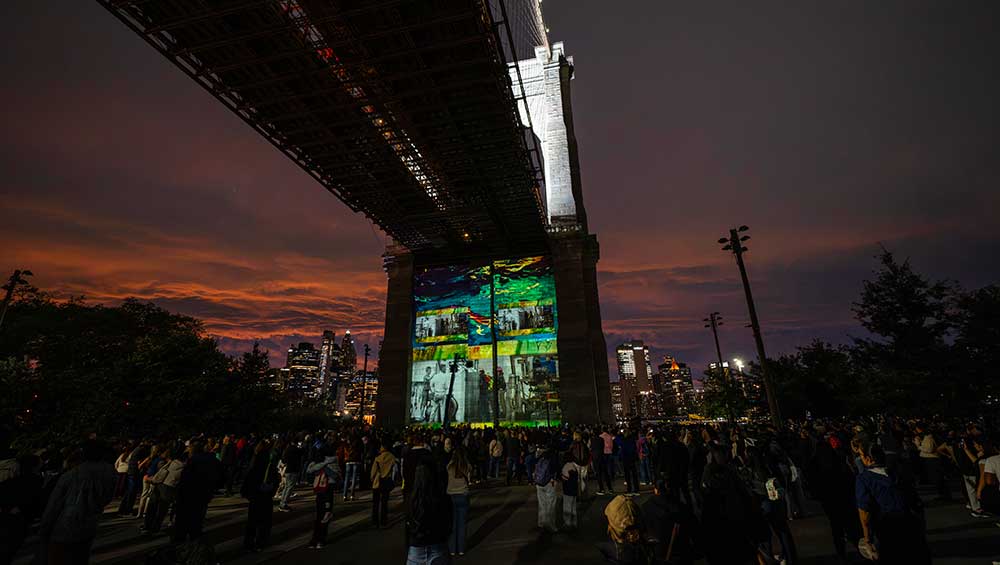
On 25 September, artist Anita Glesta transformed the Brooklyn Bridge’s east pylon into a magnificent screen that dwarfed any IMAX. It was a one-night stand due to the vagaries of the weather but Aqua Cosmos: The Hudson Canyon was luminous, a brilliantly coloured projection on an 18-minute loop that was not overshadowed by its site – other artists have not been as fortunate – the audience numbers gratifyingly large, overflowing the surrounding plaza. Glesta took us into the invisible world beneath the Atlantic about 100 miles (160km) up the coast from New York City. Showing us real and fanciful images of marine life by means of underwater footage, animation and original scientific illustrations, we are introduced to the Hudson Canyon and its richly diversified ecosystem. Created in collaboration with the Wildlife Conservation Society (WCS) and ArtW, Glesta’s project, Aqua Cosmos: The Hudson Canyon Project merges art, science and conservation into an impassioned plea to protect our many-splendored environment.
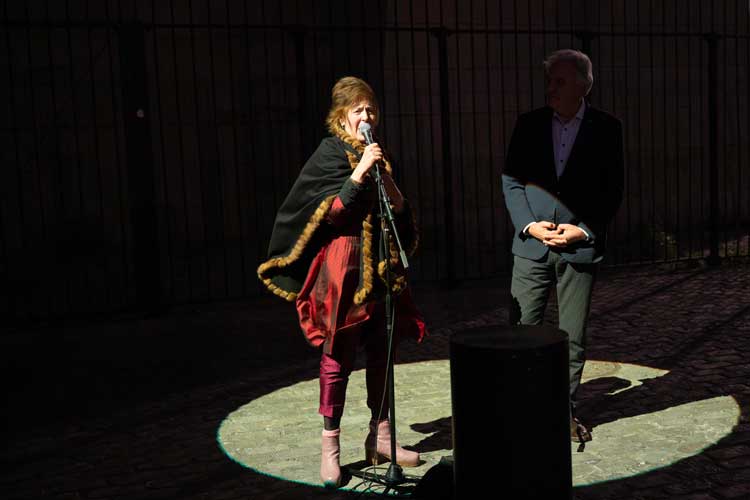
The following is an excerpted, edited conversation between Anita Glesta and Lilly Wei, discussing the project.
Lilly Wei: What drew you to the Hudson Canyon? It’s an immense submarine realm that drops almost two miles below sea level that begins at the mouth of the Hudson River, you said, and extends more than 400 miles outward across the continental shelf.
Anita Glesta: There was a talk at NY Laser (a long-running series of art and science programmes) given by Noah Chesnin, the director of policy and outreach at the WCS. That was the first time that I heard about the Hudson Canyon; I found it intriguing. It is the largest submarine canyon along the US’s Atlantic Coast – its depth is equivalent to the height of seven Empire State buildings – with a great diversity of marine species. Noah showed some images that reminded me of my Watershed project, an interdisciplinary work in which I projected fishes on to public buildings that also involved politicians, scientists and community organisers. I wanted to learn more about the Hudson Canyon. I was also struck by the fact that it didn’t yet have [National Marine] Sanctuary status.
LW: The Brooklyn Bridge is one of New York’s best known and beloved landmarks. It is also monumental. What drew you to it as a site? It must have been quite a coup, if also daunting.
AG: The Brooklyn Bridge was chosen by WCS and ArtW; they had the ability to make that happen, and, yes, I was thrilled but I didn’t find it daunting. I love working on a really large scale, which is not new to me. Watershed has been projected on the entire exterior of the Parrish Art Museum in Watermill, New York, as well as on the grand facade of the National Theatre in London.
LW: Aqua Cosmos is an interdisciplinary work that includes archival scientific illustrations, contemporary underwater footage, animation, painting and sound. Can you talk a little more about that? How did each component contribute to the overall work?
AG: I think of it as a multilayered hybrid documentary and a visual and scientific experience, which is critical to my practice. I’m a self-taught animator, and I have worked with sound on other ventures such as my Guernica project interviewing the survivors of the bombings, but I never put it together. I don’t consider myself a video artist or a documentary film-maker. I wasn’t thinking about how to weave these parts together at first, but I wanted to make it visually compelling, encompassing; the venue was extraordinary and required an extraordinarily compelling resolution. I thought of collage, and of something that was childlike, parts of it like a children’s book to balance the archival material and the recent National Oceanic and Atmospheric Administration footage. It was challenging, but also fun, to put all of that together. The juxtaposition of the original footage using fishing nets to gather specimens with new documentation using drones and choosing how to pair that was crucial. I liked the contrast of old tech and new tech – the fish, at least the species, were the same. And a great coral garden was discovered, so that was exciting.
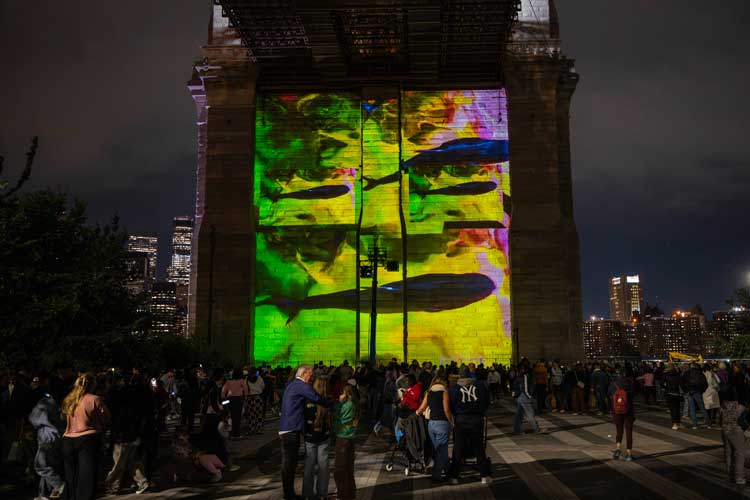
LW: The 1925 Arcturus expedition, a six-month long research trip that was the first to document this important ecosystem, is highlighted in Aqua Cosmos. Would you talk about that a little more?
AG: I was captivated on many levels by the expedition and reading the reports and journals and seeing the drawings was fascinating. But I was also fascinated by the fact that the crew included six female explorers at a time when women were still considered bad luck and a distraction on board a sailing vessel. William Beebe, the expedition’s leader, said: “If it were feasible, I would have my entire scientific party made up of [women], just as readily as not. Fine minds are as necessary in modern research exploration as fine courage. It is easier to find fine women than fine men.” These women, a third of the professional and scientific staff, were all highly accomplished. They were: Isabel Cooper (science artist), Mary Poland-Fish (fisheries scientist), Ruth Rose (historian and writer), Lillian Segal (chemist), Helen Tee-Van (science artist) and Elizabeth S Trotter (fisheries scientist). I think about these women making all those beautiful illustrations of underwater creatures, some never seen before, and also about their toughness, resilience and resoluteness.
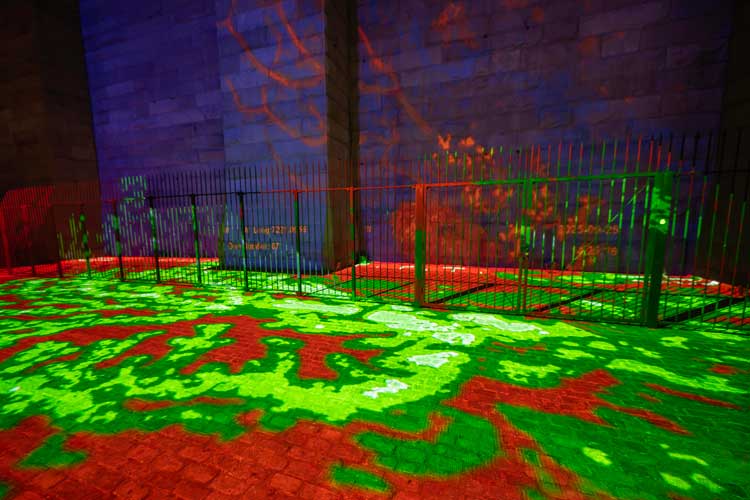
LW: And all of this before underwater colour photography was possible.
AG: Yes, and these women were celebrated. The trip received a lot of attention in the press, and the public was fascinated by them.
LW: How did you balance the factual with the imagined and the invented? Although the underwater has its own beauty and weirdness that is as uncanny as anything we can envision, even beyond what we can imagine.
AG: Everything had to be accurate and factchecked. However, I did want, consciously or not, to also have in it something that had the wonder and simplicity of a children’s book, so that viewers would feel that they were inside it, immersed in the miraculous world of marine creatures. I fantasised about that world, it became Atlantis to me, aided by Beebe’s journal. I thought of it in some ways as nature’s canyons and compared them in my mind to the urban canyons of New York City. I let my imagination fuel me as much as facts, science. In the end, Aqua Cosmos is not a nature documentary; it is much more about the poetics of the underworld, the sea world, more art than science, an odyssey that is subjective.
I am a painter, and I approached the making of Aqua Cosmos very much as I would a painting. In an unexpected way, animating my own watercolours and drawings allowed them to come alive, rekindling my love of painting on a large scale in the studio. The visual dialogue with the exquisite watercolours created by the female artists aboard the Arcturus expedition a century ago opened something up in my own practice, giving me a renewed sense of freedom and spontaneity as a painter that I hadn’t experienced in many years.
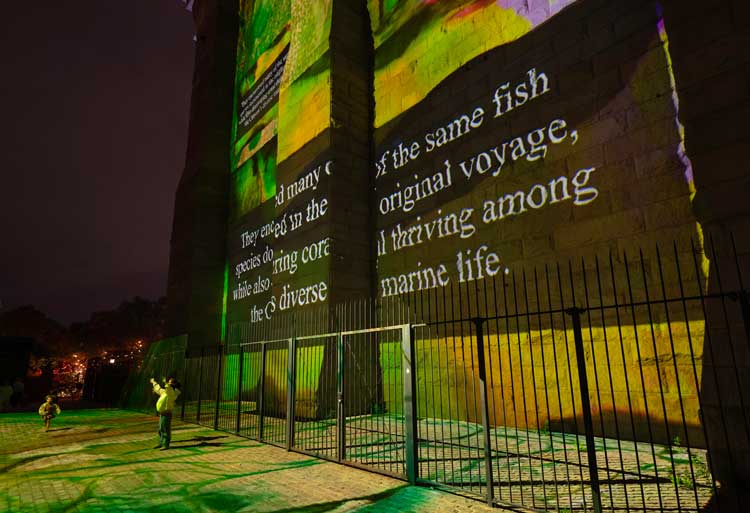
LW: Sound plays a significant part in the projection’s overall impact, including whale vocalisations and other recordings. How did you develop the sound component?
AG: I see it mostly as a visual project but there is sound: music, the sound of water lapping, the whales, and so on. Sound really amplifies the experience of watching many of the videos that I make. The scientists who gave me the whale voices that I used were scrupulous about which whale voice to use. The North Atlantic right whale has a distinctive voice, and I combined its vocalisations with those of humpback whales, later slipping in a fin whale. The scientific team immediately heard that third voice and identified it. I loved that moment because it made me realise how deeply they know these animals – not simply as data, but by their individual sounds – and how essential that knowledge is to the work of protecting them. And they noted that I accidently hadn’t included its fin. They were scrupulous about that too!
LW: Aqua Cosmos was created in collaboration with the WCS and ArtW. How did working with scientists, conservationists and an organisation supporting women in the arts affect the project?
AG: It was a way to make science more accessible, and I think it was very successful in that regard. Everyone was so generous in sharing the information that I needed. It would be wonderful to develop it further because there is so much astonishing material.
LW: The project also points to the Hudson Canyon’s aspiration for protective status as a National Marine Sanctuary. How do you address the relationship between art and advocacy? Should there be a connection?
AG: I can’t answer that for others, but it threads through my entire practice. I know that I’m not going to save the world as an artist and I can’t invent a new technology to save our planet, but I shine attention on what we might not have known before in places and events that we aren’t familiar with, as I did in my Guernica and Watershed projects, and in the piece I made on the nervous systems in our body that are affected by our emotional state. There is a moment in the video that I refer to Beebe watching the fish change colour and links it with mood, with their emotional state, which I thought was prescient. As an artist, I think I can pull out things that we don’t think about and give it a vehicle. And that might be helpful. Maybe this will help in Hudson Canyon’s bid to become a national treasure worthy of preservation.
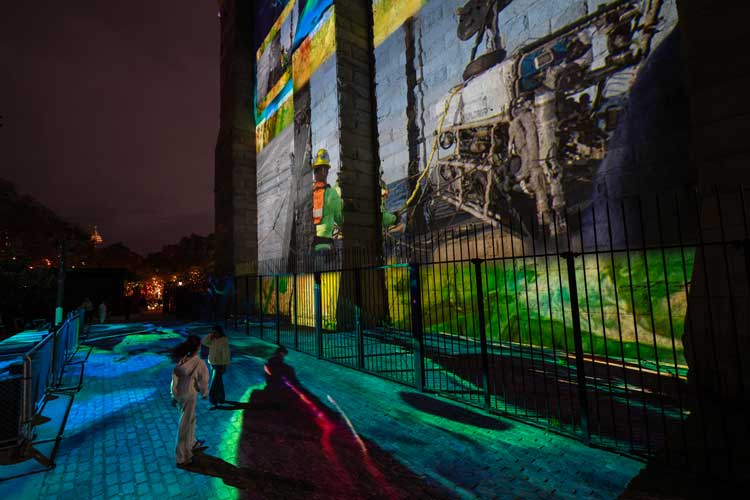
LW: What effect did you hope to convey by projecting Aqua Cosmos on the Brooklyn Bridge? It certainly looked fantastic, especially given the backdrop of the Manhattan skyline, the urban canyons you mentioned. And there were about 3,000 spectators, more than any museum or gallery could hold.
AG: Yes, attendance far exceeded my expectations, and the scale was exhilarating, but I was disappointed that the second night’s viewing was cancelled due to the prediction of a nor’easter. That is one of the downsides of outdoor art venues. And while that kind of exposure is astonishing, I would also say that if I can reach even one person, that’s wonderful, too. I was told, just by happenstance, that an eight-year old in attendance that night wrote a story about it for her class. I find that wonderful.
LW What’s next for Aqua Cosmos?
AG: I think there can be many more iterations of Aqua Cosmos because the story is so layered. It’s about the extraordinary fact that the Hudson Canyon is virtually in New York City’s backyard, those pioneering women aboard the Arcturus and the beauty of their drawings, William Beebe’s writings, and the role of the artist as a translator of science. That really interests me. At a time when there was no underwater colour photography, their drawings were one of the ways people could begin to imagine what existed beneath the surface. They weren’t simply illustrating marine life, but translating something otherwise invisible. I’ve also become very interested in the history of animation and Lotte Reiniger, who was pioneering silhouette animation in Germany in the 1920s, at almost exactly the same time as the women were working aboard the Arcturus. I love that connection – this moment when artists were finding completely new ways to make unseen worlds visible.
I can also imagine taking the current single-channel video apart and rebuilding Acqua Cosmos across multiple screens, with images moving between them. I would love to make the work more spatial and immersive. And I can also imagine another large outdoor projection in a very different setting. I’m in Italy now installing a version of Watershed, my earlier projection work, at ReCreate, an artist residency and sculpture park outside Asti. From there, I’m going to the Bogliasco Foundation near Genoa to present Aqua Cosmos during the Genoa Science Festival as part of Bogliasco’s 30th anniversary. So, in a way, the work is already beginning its next life.
• Anita Glesta’s Aqua Cosmos: The Hudson Canyon was projected on to the Brooklyn Bridge on 25 September.