Museum für Moderne Kunst (MMK), Frankfurt
17 August 2019 – 16 February 2020
by CELIA WHITE
Titled simply Museum, the current exhibition at the Museum für Moderne Kunst (MMK) in Frankfurt is framed as a radical gesture that follows the legacy of institutional critique in the late 1960s and 70s, yet with an apparently different flavour. Rather than dissembling the museum’s institutional power, the exhibition is made up of works that express art’s creative freedom, emphasising the museum’s possibilities rather than its restrictions and biases.
The show features 47 works made by 36 artists, many of whom are associated with institutional critique in its earlier forms. But problems arise at the outset, with the exhibition’s universalist claim that it is responding to “a time of constant change and the attending sense of powerlessness” and that it aims to “conceive of – and make perceivable – the Other”. Whose situation is being described here – whose experience of change, and whose powerlessness? Who or what is the exhibition’s assumed “Other”? The makeup of the show renders these questions all the more pertinent – if it is a geographical or political Other, for instance, what does it mean that almost all the artists in the exhibition come from, or work in, Europe or North America? The situation is not helped by the show’s format and its interpretation, which often dehistoricise and depoliticise the artists’ messages and contexts.

The exhibition suffers from an uneven approach to art historical discussion and a confusing geography. The building is spectacular and complex, offering both massive spaces and intimate nooks, stairways and sweeping views on to other floors. Viewers can read about the exhibited pieces via an extensive booklet with floorplan, but the layout of the space and the fact that the artworks are numbered in the booklet but not on the walls makes orienting oneself and the works a huge effort. What is more, not all the artworks on show have an explanatory text in the booklet, so for those that do not, the ideas they represent and their place in history would be lost to any viewer who is not already familiar with them. The artwork texts that are included tend to vary in length and are not always confined to the object on show – they are not descriptive captions per se – such that the booklet occupies a hazy ground between map, interpretive guide and catalogue, but often interrupts, rather than assists, the viewing experience.

The show begins with a bold minimalist statement that is perhaps fitting given the omissions highlighted above: Ryan Gander’s Looking for Something That Has Already Found You (The Invisible Push) (2019). What appears to be a blank, empty reception space in fact houses a fan that blows air around the room. It is easy to miss this work, and to be drawn instead towards a neighbouring space featuring Victoria Santa Cruz’s 1978 film Me Gritaron Negra (They Called Me Black). In this deeply political work, Santa Cruz makes a performance of the derogatory term “Negra”, repossessing it as “Negra soy” (I am black) in musical form through voice, rhythm and dance to African beats.

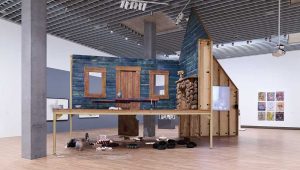
While it is not made explicit how Santa Cruz’s film reflects on the “possibilities” of the museum, an installation by Pamela Rosenkranz in a nearby space does so more obviously: canvases are propped against the walls, with plastic on the floors and painting materials scattered around, transforming the museum space into a studio – a site for generating ideas rather than presenting them. Complementing the creative transparency of these works is a large projection of Tracey Emin’s film Why I Never Became a Dancer (1995). Here, Emin narrates her adolescent journey from an enjoyment of casual sex as a form of freedom, as something you could “just do”, to the emotional abuse of men who labelled her a “slag”. Emin confides to her audience that, at the age of 15, when her sexual freedom began to be supressed and controlled by men whom she regarded as “less than human”, she turned to dance, pursuing artistic freedom instead.

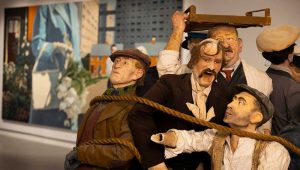
Moving upwards via MMK’s imposing stairway, we come to a room devoted to Joseph Beuys’s anti-institutional art actions. The gloves, gumshields, headgear and ropes from Beuys’s boxing match with the artist AD Christian at Documenta 5 in 1972 are paired with a well-known photograph from the same year of Beuys being escorted by police from the Dusseldorf Art Academy for protesting against its restrictive selection criteria. In both actions, Beuys used direct methods (performance, protest, violence) to advocate for democracy: the boxing match “for direct democracy through referendum” and the Dusseldorf sit-in for the human right to education for all. Sadly, the viewer has to rely on the booklet to explain this history: without this, the vital context is missed. If they do read, the objects still sit mutely on the walls, obscuring the physicality of Beuys’s anti-institutional activism. Here, the museum (and Museum) sanitises and deadens, confining the work through institutional means such as the gallery space and the printed text. Beuys’s work is often experienced in this way, but surely it is Museum, with its experimental commitment to museological possibility and artistic liberation, that should be responsible for challenging this?

Bearing in mind this need for liveness and animation in politically engaged artworks, it is unsurprising that the film pieces work best in Museum. Adrian Piper’s classic The Mythic Being (1973) aimed to deneutralise the art world of the 70s by addressing the American political climate and asserting the social potential and significance of art. The Mythic Being shows Piper dressed as her black male alter ego, walking down the street, with a wig and moustache, reciting sentences on repeat, presenting the artist as an artwork in a non-gallery context and highlighting society’s coding of male/female, black/white, art/non-art identities.

Such identities are the focus of films in neighbouring rooms, such as Rosemarie Trockel’s 1994 Die Gleichgültige (The Indifferent One), an excerpt from Jean Painlevé’s L’Hippocampe (The Seahorse) of 1934 that shows a male seahorse giving birth through a series of violent convulsions, turning on their head traditional, biological gender roles as understood and upheld by humans.

Oliver Laric’s film Untitled (2014-15) shows cartoon forms morphing gently and seamlessly into each another: from human to animal, animal to object, object to human, all set to mournful music. These brightly coloured shapes are seen against a pure white background, looking lonely, sad and ridiculous. Divorced from their narrative contexts and their characters, emotions and superpowers, they indicate the mutability of visual identity and the fleeting nature of seemingly ingrained characteristics.
Two works on the final, uppermost level of the display mirror Gander’s and Emin’s pieces from the exhibition’s earlier rooms. Another work by Piper, Adrian Moves to Berlin (2007/2017), shows the American artist dancing alone in a public square in the German capital. As with Emin’s film, dance here represents freedom from oppression – in the case of Piper, from her experiences of racism and sexism in her native US. The film was made when Piper moved away from her homeland, vowing never to return. As with Emin, who identified her hometown of Margate on the English coast as a site of her oppression in Why I Never Became a Dancer, here Piper uses her body and identity to celebrate her newfound freedom, performing this personal journey publicly for Berlin passersby to see.

In an adjacent room, Tony Conrad’s Yellow Movie 1/25 – 31/73 and Yellow Movie 3/31 – 4/2/73 (both 1973) present the viewer with large pieces of paper that appear blank except for their painted borders. In 1973, Conrad invited an audience to a premiere of 23 new films, but instead displayed 23 of these pieces of bordered paper. Rather than screens on to which films could be projected for the attending public, the paper was intended to register traces of those who stood before them – their own movements and interactions – by means of light-sensitive paint that covered their apparently blank rectangular centres. But, as with Gander’s work, the idea behind the Yellow Movie pieces is lost unless the booklet is consulted, raising the question of how MMK could have expanded the possibilities of its own museum in order to draw out the meaning of invisible works in the gallery space while also respecting their visual subtlety. In the case of Conrad’s Yellow Movie works, and as with the Beuys actions, the anti-institutional element is as much a historical one as it is a contemporary one, making it all the more problematic that an art historical framing is absent from the in-gallery display.
There is possibly something meaningful in the disruptive logic of viewing Museum. Could the unconventional shapes of the rooms, the need to keep flipping back through the booklet, the numbering in some places and its lack in others, and the inconsistency of the information all be tactics that mirror the exhibition’s premise – that the viewer exercises their own creative freedom, their own “configuration, transformation and transgression” of the museum space? This is difficult to achieve when presenting historic and contemporary works together, and where transgressive institutional behaviours in the past are at several removes from those learning about them in the present. But it seems ironic that MMK did not appear to look critically enough at its own practices and the conventions they reinforce: Museum as a show and the museum as an idea should have been regarded as synonymous, with both experiencing the same level of scrutiny and experimentation as would be applied by the artists the exhibition claims to represent. While at risk of appearing inward looking, this self-reflective approach might have delivered some of the radicalism that Museum promised. Instead, it comes across as yet another star-studded, but largely unfathomable museum show.