Kate Fahey is concerned with slowing down how we interact with images. In the age of Google, where our consumption of the visual divorces us from context and meaning, Fahey seeks to reappropriate photographs that have become lost or degraded through continual sharing
Her background in printing leads her to consider the surface of her work, the texture and nature of the paper she uses, returning tactility and poetry to digital images. The result is Cumulative Loss, a hauntingly beautiful digital collage imbued with symbolism.
Bloomberg New Contemporaries 2016 Institute of Contemporary Arts, London 23 November 2016 – 22 January 2017
Interview by EMILY SPICER Filmed by MARTIN KENNEDY
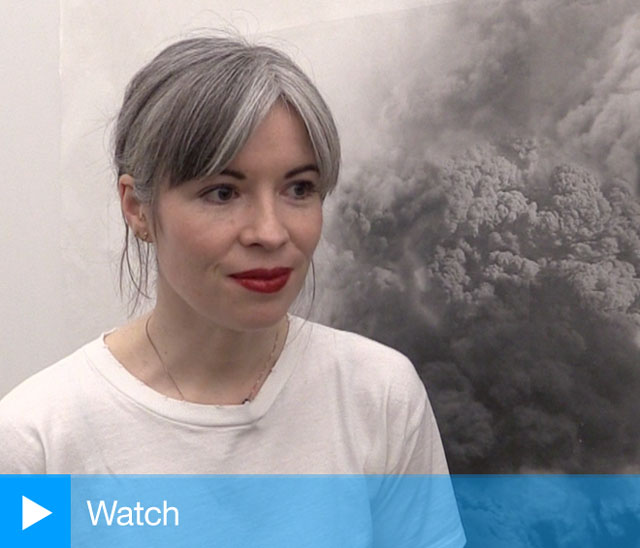
Kate Fahey talking to Studio International at the opening of Bloomberg New Contemporaries 2016, Institute of Contemporary Arts, London, London, November 2016. Photograph: Martin Kennedy.Kate Fahey talking to Studio International at the opening of Bloomberg New Contemporaries 2016, Institute of Contemporary Arts, London, London, November 2016. Photograph: Martin Kennedy.
From Ryan Orme’s inventive form of urban landscape painting to Eleonora Agostini’s weird depictions of family life and Ben Yau’s deep-dive into the history of the 1973 military coup in Chile, here are some of the best from this year’s New Contemporaries
From this annual showcase of new talent, we pick five artists to watch, from Yushi Li’s erotically charged photograph from her My Tinder Boys series to Madelynn Mae Green’s painting of three children on a bed
George Ridgway graduated last year from the Glasgow School of Art. His work traverses painting and installation with an intuitive ease as he subtly translates music, movement and the forces of the natural world into paint
Since 1949 New Contemporaries has hand-picked graduate and emerging artists to present them to the public as the rising stars of the art world. Studio International visited the touring exhibition on its opening night at the Institute of Contemporary Arts in London to speak to…
South Korean artist Seungjo Jeong creates pared-back canvases that explore the relationship between viewer and artist through the almost abstract evocation of objects