Paris comment:
e-letter from Paris
 |
| Art Populaire, Liza Lou’s Back Yard |
Paris is on the rebound. Yet the key exhibitions here so far this
year in terms of 20th century art seem not so much to represent
the traditional centrality of French culture per se, as Paris’s
sophistication and eclecticism as a reflective, intellectual core
in discourse. This is all to the good, since the largest ever exposition
of Pop Art had opened last March at the Centre Pompidou.
Les Annees Pop (The Pop Years) was intended to initiate
a wave of retro-cultural consumer bingeing in the surrounding boutiques
and stores of Paris, as well as the involvement of fashion houses
— Paris as the great interpretative centre, no less. Catherine
Grenier, chief curator of the show, intended the display to be not
only educative for the new generation unaware of the full implications
of l956—l968, but also for ‘a return to optimism’;
that spirit of l968, er, well just before, when a benign new world
might still be constructed, and a happy reconciliation of creativity
and consumerism, was aimed for. ‘The moment when the young
dream no longer of a political utopia, but can dream of a cultural
utopia. Indeed, Pop is one’.
The dream and the actualite of the show were strangely irreconcilable.
To French critics, ‘Pop’ has always seemed to be some Anglo-American
confection; ‘La Defie’ of essential lightness and ephemerality,
suffused with Anglo-Saxon humour — itself beyond Gallic comprehension.
Accordingly, the curators were allocated only limited space on the
sixth level of the Centre Pompidou, to cover all arts developments
of the genre. Given that the French contribution of the period was
significant primarily in music and film, this limitation did not
help when the various objects of Pop were jostling together in a
congested emporium of space. Perhaps there was an underlying misconception
as to what did and did not constitute Pop — and where irony
of the mid-Atlantic kind failed to be meaningful to the essential
French sense of irony. From the viewpoint of French critics, such
as Michel Nuridsany in Le Figaro, or Herve Gauville and Elisabeth
Lebovici in Liberation, the exhibition was too much a catch-all
cultural bricolage, (Dali and Duchamp notwithstanding) and the consensus
was verging on the catastrophic, as with Tate Modern’s own stab
at definition, the ill-fated Century City Show.
Which brings one to the new exhibition here which is directly comparable.
At the Fondation Cartier there has just opened Un Art Populaire
(until 4 November). Here, the product of French-defined globalism
is revealed at its best; a life-enhancing, humanising, yet curiously
innocent phenomenon. Art Brut, as defined by Jean Dubuffet
provides the initial point of definition. The professional eye of
the curators has selected the product by and large of the untrained
eye of man. Examples of genuine popular art and culture are drawn
here to Paris from several quarters; from Beishing, Kinshasa, New
Mexico, or Los Angeles. The art is manifold and diverse, linked
only by an effervescent sense of obsessive creativity. There is
none of the self-consciousness of Century City. The trained
artists from Los Angeles establish, from that culture, a perfect
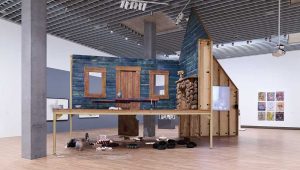
parallel to the other world’s popular manifestations. Liza Lou has
made an installation representing her back garden paradise. It is
her real garden; real, rather than contrived. From their community
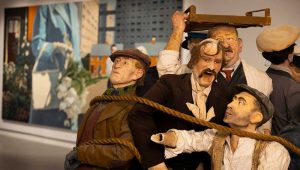
near Beijing, the Luo brothers provide a superb scenario, curiously
buddhist and yet supremely materialistic; the colliding ingredients
of the global economy seem to unite in an orchestrated tableau of
jubilation at the survival of human life. Overall, the exhibition
is suffused with an abiding modernity, with only everyday reference
systems to guide the wary. This exhibition is a curatorial and organisational
triumph.
Two remarkable sculpture-related shows have just preceded this
event, as if to consolidate the traditional role of Paris as a centre
of gravity in 20th century art and letters. The show of (mainly)
drawings and a few sculptures, celebrating the centenary of the
birth of Alberto Giacometti, at the Centre Pompidou, revealed
the working process of the sculptor. While lacking the status of
the late David Sylvester’s superb l965 Tate Gallery Giacometti retrospective,
this exhibition revealed with notable skill the extent and application
of the sculptor’s method of elimination of all that was not essential
to his objective. Giacometti’s achievement in editing down his own
concept to reach the final state of grace is brought home to the
viewer in seeing the small group of figurative sculptures included.
The second exhibition of a kind here was the show ‘Rodin
in l900; the Alma Exhibition’ at the Luxembourg Museum
(Palais Luxembourg). Here was the antithesis of conceptual
art; sculpture in process in primary form, as of clay and plaster
casts. The exhibition commemorates Rodin’s successful effort in
curating his own work in l900. So, the artist’s view of himself
remains central, accordingly exemplified by his chosen model casts.
The essential fluidity and temporality of clay and plasterwork presents
an instantaneity that the bronzes can never possess. In this climate
then, of burgeoning impressionism in art, it was up to Rodin to
render an equivalent, epitomised by the sheer fact of non-completion,
where faces are provisional — rough texture and displaced limbs
going together in freedom from chronology. So these superb Rodins
of a penultimate state emphasise the vitality of process as a condition
of form, disregarding the lifelessness of the bronze figures ultimately
made.
As if to remind us of the importance of Paris as cultural arbiter,
the Centre Pompidou has again provided a fascinating reappraisal
of the importance of Alfred Hitchcock as film maker and cultural
influence, in Hitchcock et l’Art (through 24 September).
Here, the great Anglo-American director is accorded a major tribute
from the intellectual centre of 20th century film. Hitchcock is
placed up in the Hall of Fame, not only with Jean – Luc Godard (whose
London retrospective is now at hand) but with the leading sculptors,
painters, and graphic artists of his generation. From Paris, that
is again something.